Chocolate Room
Charlie and the Chocolate FactoryThe Chocolate Room is the nerve centre of Wonka's factory and its decisive first revelation. Behind a shiny metal door, the visiting children and adults discover not an ordinary production floor but a complete valley built around a river of hot melted chocolate. The room converts the factory's hidden machinery into a landscape of beauty and excess, making Willy Wonka's confectionery genius physically visible while placing Charlie Bucket's deepest longing at the heart of the spectacle.
Entrance and Spatial Design
The room is reached through increasingly steep passages that slope downhill before Willy Wonka stops at a shiny metal door marked "THE CHOCOLATE ROOM." He opens it with a key, and five children and nine grown-ups push inside together. The threshold creates an abrupt transition from enclosed corridors to a vast apparent outdoors: a valley, green meadows, a river, a waterfall, trees, bushes, and thousands of buttercups. The room is therefore both a factory chamber and an imitation landscape, with industrial architecture disguised as natural abundance.
Willy Wonka calls the room the heart of the business and insists that it must be beautiful because he cannot tolerate ugliness in factories. His aesthetic rule governs the entire space. The river is surrounded by weeping willows, alders, and flowering rhododendrons; the meadows are covered with buttercups; and even the grass beneath the visitors is edible. The room's beauty is not separate from manufacture. Every attractive feature is also a product, ingredient, or demonstration of confectionery invention.
Chocolate River and Industrial Machinery
The river is not merely brown water or a decorative stream. Willy Wonka reveals that every drop is hot melted chocolate of the finest quality. He claims that its quantity is enough to fill every bathtub and swimming pool in the entire country, turning chocolate from a rare pleasure into an almost unimaginable national-scale resource. The claim reverses Charlie Bucket's ordinary experience: in his impoverished household, chocolate is a once-a-year birthday treasure, carefully preserved in a small wooden box and eaten in tiny nibbles so that one sixpenny bar lasts more than a month.
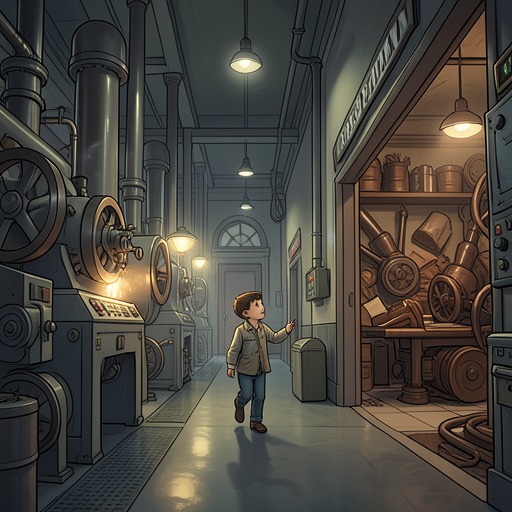
The room also exposes the machinery that makes this abundance possible. At least a dozen enormous glass pipes hang from the ceiling and descend into the river, sucking up the chocolate and carrying it to other rooms throughout the factory. Their transparency allows the visitors to see the liquid bubbling and flowing inside them, while the repeated sound of their operation continues above the waterfall. The pipes make production visible without making it ordinary: industrial extraction becomes another part of the room's astonishment.
The waterfall performs a crucial manufacturing function. It churns, pounds, beats, and mixes the chocolate, making it light and frothy. Willy Wonka presents the method as unique, insisting that no other factory mixes chocolate by waterfall and that this is the only proper way to do it. The room thus joins spectacle to technical authority. Its marvels are not random decorations; the waterfall and pipes form a production system whose efficiency is expressed through theatrical excess.
Edible Landscape and the Visitors' Response
The valley's natural forms are made from different delicious substances. Willy Wonka identifies the grass as a soft, minty sugar that he has invented and calls swudge, then urges the children to try a blade. This detail establishes the room's governing principle: the apparent distinction between environment and commodity has disappeared. Trees, bushes, grass, flowers, river, and waterfall all belong simultaneously to nature-like scenery and to Wonka's product world.
The visitors are overwhelmed by the scale and strangeness of what they see. They become flabbergasted, staggered, dumbfounded, bewildered, and dazzled, standing silently and staring. Their response matters because the room is designed to defeat ordinary judgment. The spectacle is too large to be absorbed as a simple explanation of chocolate manufacture; it produces wonder before it produces understanding. Willy Wonka, meanwhile, dances up and down and points with his gold-topped cane, acting as guide, demonstrator, and master of ceremonies within the space he has made.
Mystery, Production, and Publicity
The Chocolate Room gains additional force from the factory's prior history of secrecy. Willy Wonka once employed thousands of workers, but dismissed every one after rival chocolate makers sent spies to steal his recipes. He closed the gates, chained them, and left the factory silent and deserted: the chimneys stopped smoking, the machines stopped whirring, and no sweets were made. Later, production mysteriously resumed without the gates reopening or Willy Wonka appearing in public. Chocolates and sweets emerged through a special trap door and were collected by Post Office trucks, while tiny figures were glimpsed behind windows.
The Chocolate Room is the spectacular answer to that mystery. It proves that the factory is active, technologically elaborate, and capable of producing on a fantastic scale, yet it does not explain the full organization behind the production. The visitors can see the pipes, waterfall, and chocolate, but the wider labor system remains concealed. The room therefore makes the factory more legible as a machine and more mysterious as a social world.
Its abundance also belongs to a larger publicity mechanism. Willy Wonka's announcement promises five children a personal tour, access to the factory's secrets, and enough sweets to last their households for the rest of their lives. The Golden Ticket hunt then becomes a worldwide chocolate-buying frenzy, with adults and children tearing open wrappers, smashing piggy banks, and even pursuing extravagant or fraudulent methods to find tickets. Newspapers, reporters, and photographers turn the fifth find into public pandemonium at the Bucket home. The Chocolate Room supplies the visual reality behind that campaign: the factory is not simply selling bars but selling access to a world where chocolate appears limitless.
Narrative and Thematic Significance
For Charlie Bucket, the room is the material fulfillment of a deprivation established from the beginning. His family can afford only bread and margarine, boiled potatoes and cabbage, and cabbage soup, and his parents often surrender their own portions to give him more. Chocolate is the thing he wants above everything else, yet he normally encounters it only behind shop windows or in the hands of other children. The Chocolate Room magnifies that private hunger into a landscape large enough to contain a country's bathtubs and swimming pools.
The room also dramatizes the transformation of a commodity into an experience. Chocolate is simultaneously food, treasure, industrial output, scenery, technology, and advertising promise. The factory later imagines an even more direct form of commercial power: Willy Wonka proposes that a television viewer might reach out from home and take a Wonka chocolate from the screen. The Chocolate Room anticipates this fantasy by making the product's production process itself into entertainment, turning the visitor into a witness who can carry the spectacle beyond the factory.
At the same time, the scene preserves a tension between generosity and control. Willy Wonka offers wonder, edible abundance, and lifelong supplies, but he controls the keys, the routes, the rooms, the information, and the rules of admission. The Chocolate Room is therefore both an invitation and a demonstration of ownership. Its beauty persuades the visitors to surrender to amazement; its machinery reminds them that the abundance belongs to the person who designed and governs the space. In that combination of nourishment, mystery, manufacture, and spectacle, the room becomes the clearest emblem of Wonka's factory itself.